Accreditation Statement: The Master of Science (M.S.) education program (residential) at Minnesota State University, Mankato is accredited by the Council on Academic Accreditation in Audiology and Speech-Language Pathology of the American Speech-Language-Hearing Association, 2200 Research Boulevard, #310, Rockville, MD 20850, 800-498-2071 or 301-296-5700. Student Outcome Data
High value degree in high demand
If you are passionate about helping others and have an interest in understanding, treating and working with children and adults who have impaired communications due to disease, injury or disability, a degree in Communication Sciences and Disorders (CSD) from Minnesota State University, Mankato may be for you!
More about Minnesota State Mankato's Communication Sciences and Disorders Program
Statement on Dismantling Racism and Striving for Equity
As a racially equitable program we have the capability to transform and dismantle inequities and racism in educational and healthcare settings and in the field of audiology and speech-language pathology.
Real World Experiences
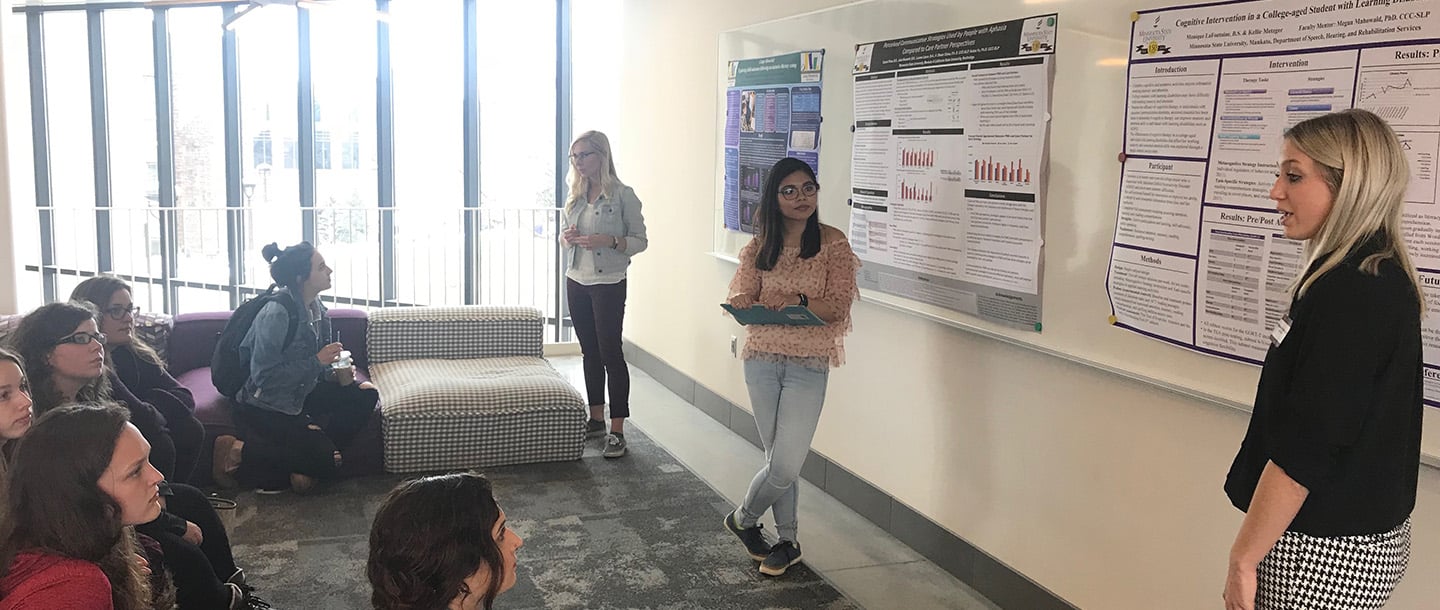
Our fully-accredited program focuses on learning to address communication challenges across ethnic, cultural, lingusitic, social and economic backgrounds through real-world community experiences, student groups, research opportunities and clinical experiences in our state-of-the-art Center for Communication Sciences and Disorders.
Communication Sciences and Disorders News
-
You Heard Correctly: Communication Sciences and Disorders professor on African American English
-
College to provide free dental, health services during Health for Heroes
 We love to share updates about the great work and activities our students are involved with - please follow us on Facebook for all the latest!
About Communication Sciences and Disorders
Learn more about our nationally-ranked program and get specific resources to support your education.
Communication Sciences and Disorders, BS
See all program requirements, including general education classes, courses within the major and a sample four-year plan.
Communication Sciences and Disorders, MS
See program requirements, course listings and a sample degree plan for the MS in Communication Sciences and Disorders.
Minor in Communication Sciences and Disorders
If you're pursuing a minor in Communication Sciences and Disorders, you'll need to meet these requirements and plan to meet with your advisor to identify appropriate classes.
American Sign Language Certificate
Learn more about courses to complete an undergraduate certificate in American Sign Language.
Communication Sciences and Disorders, Post-Baccalaureate
The post-baccalaureate program in Communication Sciences & Disorders is a series of courses required prior to applying for graduate school in speech-language pathology or audiology.